April's Secret Gardens: Where China's Alpine Meadows Explode With Color Before the Crowds Arrive
Discover China's secret April wildflower season: alpine meadows in Sichuan, Qinghai, and Xinjiang explode with color before summer crowds arrive.
The April Advantage: Why Smart Hikers Skip July
Most travelers mark July and August on their calendars for China's wildflower season. They'll fight through busloads of tourists at Jiuzhaigou, queue for hours at Yading, and wonder why every meadow feels like a parking lot. The hikers who understand China's elevation gradients know better. April unlocks something rarer: alpine meadows at lower elevations hitting peak bloom while snow still caps the higher ridges, trails nearly empty of summer crowds, and a quality of light that photographers chase across three provinces.
The secret lies in how elevation compresses spring. While Shanghai's cherry blossoms finish in late March, the vertical rise from Sichuan's valleys to its alpine zones can stretch a single season across two months. A meadow at 3,200 meters might reach full bloom in mid-April, while another just 800 meters higher remains locked under snow until June. This creates narrow windows where accessible trails offer explosive color without the logistical headaches of true high-altitude trekking.
We've mapped three distinct regions where April 2026 promises exceptional conditions, each with verified bloom calendars and trail data from local forestry stations and alpine research teams.
Sichuan's Eastern Escarpment: The Wild Azalea Corridors
The Daxiangling and Xiaoxiangling ranges east of the Hengduan Mountains core receive less attention than their famous western cousins, but their lower elevation profile makes them April specialists. Here, the transition zone between subtropical valleys and alpine terrain creates compressed ecosystems where rhododendrons and primulas carpet slopes that would be snowbound at comparable latitudes in Yunnan.
Shenmulei Meadow (3,400m) near Shimian County represents perhaps the most reliable April bloom in Sichuan. Local records from the Shimian Forestry Bureau document peak rhododendron displays between April 12-28, with Rhododendron oreodoxa and R. aganniphum forming dense thickets in pink and magenta concentrations. The approach trail from Caoke Township gains 1,200 meters over 14 kilometers, with the final 4 kilometers traversing active snowmelt zones where waterproof boots become essential.
Trail difficulty rates moderate-to-challenging primarily due to stream crossings rather than steep gradients. April 2026 hikers should expect 6-8 hours of walking time with full packs, and the meadow itself offers limited shelter—planning for rapid weather changes matters more than technical climbing skills.
Further north, Jiajin Mountain's eastern approaches (3,100-3,600m) present a gentler alternative with comparable floral density. The Red Army Long March trail segments here have been partially restored, creating a 22-kilometer loop that passes through three distinct elevation bands. Primula sikkimensis and P. denticulata dominate the lower meadows in pale yellow and violet drifts, while the upper zones feature the compact cushions of Saxifraga species adapted to lingering snow patches.
Temperature data from the Jiajin Mountain Weather Station (3,450m) shows average April highs of 11°C and overnight lows of -3°C, with precipitation falling on roughly 40% of days. Morning fog burns off by 10:30 AM most days, creating the golden-hour conditions that persist through early afternoon at these latitudes.
Qinghai's Southeastern Gateway: The Sanjiangyuan Fringe
The Sanjiangyuan National Nature Reserve proper remains largely inaccessible in April, with core areas above 4,500 meters still under deep snow. But its southeastern transition zone—where the Tibetan Plateau begins its descent toward Sichuan—harbors meadows that bloom remarkably early due to rain shadow effects and thermal pooling in valley systems.
Maqin County's Xueshan Township region (3,600-4,000m) sits at the convergence of the Yellow River's upper tributaries, creating microclimates where Meconopsis poppies and Gentiana species establish April footholds. The 2024-2025 monitoring data from the Maqin County Grassland Station recorded first Meconopsis integrifolia blooms on April 8 at 3,650 meters, with peak density reached by April 20. These are the yellow poppies Tibetans call "kongque" (peacock), their petals saturated with carotenoid pigments that seem to generate their own light against the still-brown surrounding slopes.
Access requires more commitment than Sichuan alternatives. The drive from Maqin town to trailheads takes 3-4 hours on roads that deteriorate rapidly with spring freeze-thaw cycles. Local Tibetan families operate basic homestays in Xueshan and neighboring Xiadawu Township, though English remains essentially nonexistent—arranging guides through Maqin's few guesthouses proves essential for navigation and cultural protocol.
The Anyemaqen pilgrimage circuit's lower segments offer another Qinghai option, though with significant caveats. The full kora around this sacred peak remains snow-impassable in April, but the approach from the southeast through Zhaling Lake's outlet wetlands provides 15-20 kilometer day-hike possibilities. Potentilla anserina and early Pedicularis species create gold and crimson patches in the meadow systems between 3,800-4,100 meters, with the massive bulk of Anyemaqen visible across the plateau when weather permits.
Altitude effects hit harder here than in Sichuan. The jump from Maqin's 3,700 meters to hiking elevations of 4,000+ meters demands genuine acclimatization—arriving from sea level and attempting immediate hiking courts serious altitude illness risk. Building in 48 hours of rest at Maqin elevation before trail access represents minimum prudent practice.
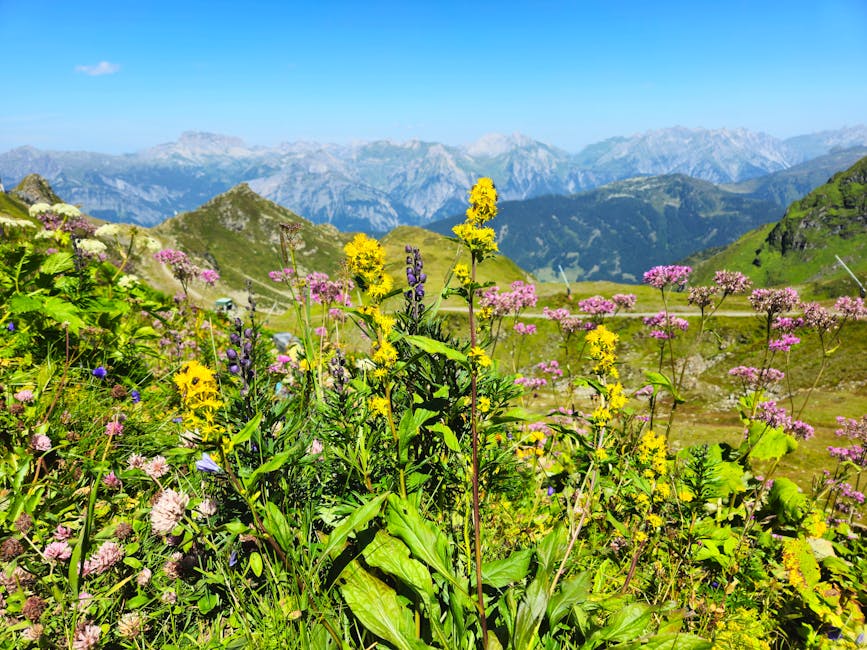
Xinjiang's Western Rim: The Tianshan Snowmelt Meadows
The Ili Valley and its surrounding ranges present China's most dramatic April wildflower contrast: desert-steppe dryness at valley bottom giving way to snow-fed alpine abundance within vertical kilometers. The Tianshan's northern slopes capture moisture from weather systems that cross Kazakhstan, creating precipitation gradients that would be extreme at any latitude.
Nalati Grassland's upper zones (2,800-3,200m) transform from winter brown to floral carpet with remarkable speed once snowpack releases. The 2025 bloom monitoring by the Xinjiang Institute of Ecology and Geography documented Tulipa iliensis emergence beginning April 5 at 2,850 meters, with Iris tigridia and Eremurus chinensis following in succession through late April. These aren't meadow flowers in the traditional sense—they're steppe specialists adapted to brief growing seasons, creating scattered but spectacular displays across slopes that will be uniformly green by June.
The Nalati Scenic Area's commercial development complicates access. The main valley road and its shuttle bus system serve mass tourism, but the Koksu River tributary valleys northeast of the main attraction maintain trail networks used by Kazakh herders that see virtually no foreign foot traffic. Reaching these requires private vehicle arrangement from Yining (Ghulja) and willingness to navigate unmarked terrain—rewards include Fritillaria pallidiflora populations and the pale blue sheets of Myosotis sylvatica that colonize recent alluvial deposits.
Zhaosu County's Tekes River basin pushes higher and later, with optimal conditions typically arriving in late April rather than early month. The Tianshan Grand Canyon trail system here gains elevation through conifer forest before emerging into subalpine meadows where Paeonia anomala and Adonis tianschanica create the red-yellow color combinations that draw botanical photographers from across Central Asia. Elevation ranges from 2,400 meters at trailheads to 3,400 meters at upper meadow viewpoints, with snow depth varying dramatically by aspect—south-facing slopes may be entirely bare while north-facing gullies retain drifts through early May.
Temperature volatility defines the Xinjiang experience. The same weather station data that confirms April's floral potential also records temperature swings of 25°C within single days—afternoon warmth that encourages short sleeves, followed by evening conditions that demand full insulation. The region's famous winds compound everything, with sustained 40+ km/hour gusts common in valley systems.
Gear Systems for the Snowmelt Season
April alpine hiking in China demands equipment choices that acknowledge contradictory conditions: intense solar radiation at altitude, active moisture from melting snow, and temperature ranges that span three seasons within hours.
Footwear represents the critical decision point. Trail runners and light hiking shoes that serve well for summer trekking fail catastrophically in snowmelt conditions. The stream crossings that characterize April trails—snow bridges weakened, fords running high with glacial melt—require boots with substantial ankle support and waterproof-breathable construction. Full leather traditional boots prove unnecessarily heavy, but mid-cut models with rigid shanks for stone stability and membrane liners for water resistance separate successful hikes from miserable retreats. Carry lightweight camp shoes for stream crossings when depths exceed boot height; the alternative of wet feet for hours courts both discomfort and genuine cold injury risk.
Layering systems must handle the solar-thermal paradox. At 3,500 meters in April, UV intensity approaches levels that cause burns in under 30 minutes of exposure, yet ambient air temperatures may remain near freezing. The solution is sun protection integrated with insulation: wide-brimmed hats or legionnaire-style caps with neck flaps, lightweight long-sleeve base layers in light colors that reflect radiation, and shell systems that can ventilate without exposing skin. Merino wool base layers outperform synthetics for odor management on multi-day trips where washing opportunities are limited.
Shelter and sleep systems require contingency planning for conditions worse than forecast. The temperature ratings on Chinese-market sleeping bags often assume optimistic interpretations of "comfort" versus "survival" limits. For April alpine use, bags rated to -5°C comfort provide adequate margin for 3,000-4,000 meter elevations, with sleeping pad R-values of 4+ essential for ground insulation from cold, wet soils. Tent selection balances weather protection against weight—double-wall designs with robust pole structures handle the wind and potential snow loads that destroy ultralight shelters.
Navigation and communication infrastructure varies dramatically by region. Sichuan's more developed trail systems maintain intermittent cell coverage, while Qinghai and Xinjiang backcountry areas may have no signal for days. Downloaded offline mapping (Gaode Maps and OpenStreetMap derivatives both serve well) and satellite communicators for emergency messaging provide essential backup. The April season precedes most rescue infrastructure's operational readiness—helicopter evacuation remains impossible in many areas until snow conditions stabilize, and road access to trailheads can be blocked by landslides or bridge damage from spring runoff.
Reading the Calendar: 2026-Specific Considerations
Climate variability makes precise bloom prediction impossible, but long-term patterns suggest April 2026 timing. The El Niño-neutral conditions forecast for early 2026 typically produce relatively normal spring progression across western China, without the extreme earliness of strong El Niño years or the delayed snowmelt of major La Niña events.
For planning purposes, target April 15-25 as the core window across all three regions, with Sichuan's lower elevations viable from April 10 and Xinjiang's higher areas potentially requiring the month's final week. The Qinghai options sit in the middle, with greatest reliability around April 18-28.
The crowds that transform China's alpine tourism in July remain absent in April. The trade-offs—colder nights, uncertain stream crossings, limited services—reward hikers who've prepared appropriately. These meadows have bloomed through April for millennia. The difference in 2026 is simply that more people now know to look for them.
You Might Also Like