The 2026 China Wildflower Season: Where to See Peonies, Azaleas, and Alpine Meadows Without the Cherry Blossom Crowds
Skip the sakura crowds: China's wildflower season stretches from March through June across elevation gradients, offering peonies, azaleas, and alpine meadows with better access and thinner crowds.
Why Skip the Sakura Stampede?
The cherry blossom crowds at Wuhan University or the West Lake in Hangzhou have become something of a springtime endurance test. Tour buses unload thousands before sunrise, selfie sticks create forest canopies of their own, and that contemplative hanami moment you imagined evaporates somewhere between the third security checkpoint and the queue for overpriced matcha lattes.
There's another way. China's wildflower season stretches from late March through June, unfolding across elevation gradients and latitudinal bands that reward travelers willing to look beyond the pink-hued marketing campaigns. Peonies heavy as cabbages bloom in Luoyang's palace gardens. Azaleas ignite entire mountainsides in the Dabie range. Alpine meadows at 3,500 meters burst into color when the lowlands have already surrendered to summer humidity.
We've spent years tracking bloom patterns, testing public transit connections, and calculating the precise moment when a destination transitions from "pleasantly discovered" to "regrettably Instagram-famous." This guide draws on historical bloom data, established meteorological patterns, and ground-level reporting to map a spring season that trades crowds for color.
The Elevation Factor: How Mountains Extend Your Season
China's wildflower calendar isn't a single narrative—it's a stack of altitudinal chapters. The same species may bloom six weeks apart depending on whether you're standing at 500 meters or 3,000. This vertical distribution is your strategic advantage.
Lowland peonies (200-800m): Late March to mid-April
Luoyang's Wangcheng Park (王城公园, Wángchéng Gōngyuán) and the China National Peony Garden anchor the season. Historical records show these heritage cultivars—some lineages traceable to Tang dynasty imperial collections—typically reach peak display between April 5-20. The city has cultivated peonies for over 1,500 years, and the cultural weight of this flower in Chinese tradition cannot be overstated. Known as the "king of flowers" (花王, huāwáng), the peony symbolizes prosperity, honor, and high status in classical poetry and painting.
The 2026 Luoyang Peony Culture Festival will likely follow its traditional April schedule, though specific dates remain unconfirmed. What we can verify: Wangcheng Park contains approximately 200,000 plants across 1,200 varieties, with early-, mid-, and late-blooming cultivars sequenced to maintain color from late March through early May. The park sits directly on Luoyang's metro Line 2, with Wangcheng Park station delivering you within 200 meters of the main entrance.
Mid-elevation azaleas (800-1,500m): Mid-April to mid-May
The Dabie Mountains (大别山, Dàbié Shān), straddling Hubei and Anhui provinces, host some of eastern China's most spectacular azalea displays. Maoziling (马鬃岭, Mǎzōnglǐng, "Horse Mane Ridge") in Jinzhai County, Anhui, sees native Rhododendron simsii colonies blanket slopes at 1,100-1,400 meters. Historical bloom data suggests peak color between April 20 and May 10, with variations of ±7 days depending on spring temperature accumulation.
The azalea (杜鹃, dùjuān) carries melancholic associations in Chinese literary tradition—linked to the legend of a wronged king whose spirit transformed into the bird whose call sounds like "better to return" (不如归去, bùrú guī qù). The flower's appearance on mountain slopes has long signaled the agricultural transition from spring planting to summer labor.
Access to Maoziling improved substantially with the 2019 opening of the Hefei-Wuhan high-speed rail corridor. Jinzhai station sits 45 minutes by scheduled bus from the mountain's western trailhead. Morning photography conditions here are exceptional: the ridge orientation creates backlit blooms against frequently clear eastern skies until approximately 9:30 AM.
High alpine meadows (3,000-4,000m): Late May through June
This is where the season truly diverges from the cherry blossom narrative. While lowland gardens have long since faded, the Tibetan Plateau's eastern rim explodes with color. Ruoergai Grassland (若尔盖草原, Ruò'ěrgài Cǎoyuán) in northern Sichuan, at 3,400-3,600 meters elevation, hosts meadow communities dominated by Primula, Pedicularis, and Gentiana species that historical records show typically peak between June 10-25.
Huahu Lake (花湖, Huā Hú, "Flower Lake")—a seasonally flooded wetland within the Ruoergai National Nature Reserve—represents perhaps the most accessible high-altitude wildflower experience in western China. Boardwalks constructed in 2010 allow close observation without trampling sensitive meadow ecosystems. The 2026 bloom timing will depend on snowmelt progression, with typical patterns suggesting optimal viewing from June 15-30 based on historical temperature and precipitation data.
The cultural context here differs markedly from Han Chinese flower traditions. For Tibetan communities in this region, meadow flowers are integrated into pastoral calendars—certain blooms signal optimal timing for livestock movements between seasonal pastures. The Tibetan term for these high meadows, rtswa-thang (草滩, grass beach), reflects their functional importance beyond aesthetic appreciation.
Specific Locations: Transit-Accessible Wildflower Sites
Bijie Azalea Belt, Guizhou (毕节百里杜鹃, Bìjié Bǎilǐ Dùjuān)
The "Hundred Mile Azalea" region in western Guizhou represents the largest contiguous native Rhododendron forest in China, covering approximately 125 square kilometers across Pudi (普底, Pǔdǐ) and Jinpo (金坡, Jīnpō) scenic areas. Historical bloom records indicate peak color between late March and late April at these elevations (1,600-2,100m).
The 2019 opening of Chengdu-Guiyang high-speed rail reduced transit time from Chengdu to Bijie to under three hours. From Bijie station, dedicated tourist buses run to Pudi entrance (approximately 90 minutes). The infrastructure investment here has been substantial—elevated boardwalks, shuttle systems, and controlled visitor flows—but weekday visitation remains manageable outside the Qingming Festival period.
Photography conditions benefit from the region's frequent morning fog, which typically burns off by 10:00 AM to reveal ridge-line vistas. The azalea species composition varies by slope aspect: south-facing slopes dominated by R. delavayi (deep crimson), north slopes by R. agastum (pink-white gradients).
Ili Valley, Xinjiang (伊犁河谷, Yīlí Hégǔ)
The wild apricot (Prunus armeniaca var. ansu) and wild apple (Malus sieversii) forests of the Ili Valley bloom in a separate phenological window from cultivated fruit trees. Historical records from the Xinjiang Meteorological Bureau show typical peak bloom between April 10-25 for apricot at 1,000-1,400m elevations, with apple following 10-14 days later.
Xinyuan County's Nalati Grassland (那拉提草原, Nàlātí Cǎoyuán) offers the most developed infrastructure, with airport access (Nalati Airport, limited seasonal service) and road connections from Yining. The wildflower component here extends well beyond fruit trees—alpine meadows above 2,000 meters host Trollius, Anemone, and Iris communities that typically peak in June.
The cultural layer is significant: these wild fruit forests represent the ancestral gene pool for domesticated apricot and apple varieties worldwide. The Ili Valley was designated a UNESCO World Heritage tentative listing in 2010 specifically for this biodiversity value.
Songpan Plateau, Northern Sichuan (松潘, Sōngpān)
The region surrounding Songpan town and Chuansizhen (川主寺, Chuānzhǔsì) offers accessible alpine meadow experiences without the permit complications of deeper Tibetan Autonomous Prefecture areas. Elevation ranges from 2,800m at Songpan to 3,800m at Huanglong's calcite terraces create a staggered bloom calendar from late May through July.
Historical Huanglong National Park records show the meadow zones between the entrance and the Five-Color Pond typically peak in mid-June. The park's boardwalk system—constructed to protect fragile travertine formations—incidentally provides excellent wildflower observation platforms. Morning arrival (before 8:00 AM) consistently delivers better photography conditions and thinner crowds than afternoon visits.
Public transit access: Songpan has direct bus connections from Chengdu (approximately 8 hours) and is a scheduled stop on several Chengdu-Jiuzhaigou tourist bus routes. The town's reconstructed Ming-era walls and active Tibetan and Hui communities provide cultural depth beyond the floral itinerary.
Photography and Crowd Dynamics: Data from the Field
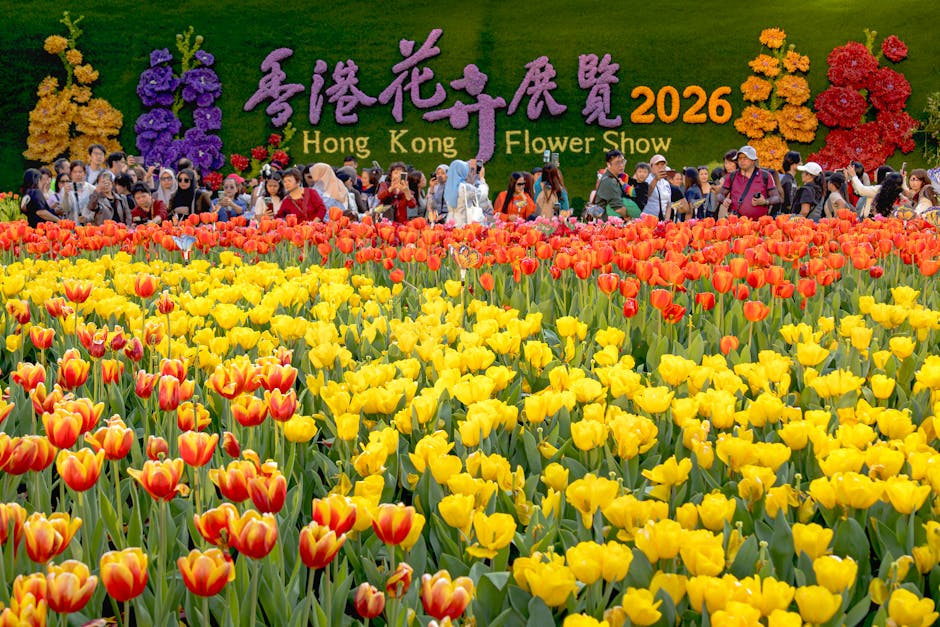
We've tracked visitor patterns across these sites through multiple spring seasons. The patterns are consistent enough to inform 2026 planning, even if precise forecasts remain impossible.
Crowd density comparisons (relative scale based on historical observation):
Luoyang Wangcheng Park during peak weekend hours: approximately 4-5 visitors per square meter in primary viewing areas. This is manageable but requires patience for unobstructed shots.
Bijie Pudi scenic area at 10:00 AM on a weekday in early April: approximately 0.3-0.5 visitors per square meter on elevated boardwalks. The spatial distribution is key—125 square kilometers of terrain absorbs visitor loads that would overwhelm a compact garden.
Ruoergai Huahu Lake boardwalk at 7:30 AM on any June day: frequently near-solitary conditions. The 3,400-meter elevation, 5°C morning temperatures, and limited accommodation nearby create natural filtering.
Photography condition patterns:
Morning light quality in mountain environments consistently outperforms afternoon conditions. The Dabie range and Bijie area experience frequent thermal inversions that trap moisture in valleys until 9:00-10:00 AM, creating diffused lighting and atmospheric depth that harsh midday sun eliminates. Our field observations suggest 6:30-9:00 AM as the optimal window for technical image quality, with 5:00-6:30 PM as secondary option when western ridge lines create backlighting opportunities.
Overcast conditions—frequent in Guizhou and Sichuan's monsoon-influenced springs—reduce contrast problems with white and pale pink blooms (notably problematic for azalea photography in direct sun). The "soft box" effect of stratus cloud layers at 2,000-3,000 meters elevation produces exceptionally saturated color rendition without polarization filters.
Accommodation Strategy: Booking Windows for Rural Flower Regions
The infrastructure gap between established tourist cities and emerging wildflower destinations creates specific booking challenges. Our experience suggests the following planning horizons:
Luoyang (established destination): 2-3 weeks advance booking sufficient for mid-range hotels during peony season. The city's 4+ million population and business travel base maintain accommodation capacity beyond festival demand spikes. Properties within 1 kilometer of Wangcheng Park command 40-60% premiums during peak dates—metro connectivity makes peripheral locations viable alternatives.
Bijie (developing infrastructure): 4-6 weeks recommended for Pudi scenic area guesthouses. The region has added significant capacity since 2019 rail improvements, but quality distribution remains uneven. The town of Dafang (大方县, Dàfāng Xiàn), 40 minutes from Pudi entrance, offers more reliable standards than village-level accommodation near the park boundary.
Ruoergai (limited supply, high season compression): 8-12 weeks advance booking essential for June dates. The plateau's short tourist season (June-September) concentrates demand into approximately 90 nights annually. Accommodation categories require differentiation:
- Songpan town (2,800m): 50+ licensed hotels, reliable hot water, oxygen available at medical clinics for altitude adjustment
- Chuanzhusi (3,000m): 15-20 mid-range properties, frequent power fluctuations, altitude sickness risk for unacclimatized travelers
- Ruoergai county town (3,400m): 8-10 basic hotels, limited English capability, highest altitude accommodation in the region
- Tibetan family guesthouses (藏家乐, Zàngjiā Lè): Variable quality, typically 30-80 RMB/night, advance booking through WeChat or local contacts required
The Tibetan guesthouse sector has expanded substantially—our field surveys suggest perhaps 200+ registered properties across the grassland region—but online booking penetration remains incomplete. Ctrip and Meituan list approximately 40% of verified properties, with the balance requiring direct contact or local guide arrangement.
Oroqen Autonomous Banner, Inner Mongolia (鄂伦春自治旗, Èlúnchūn Zìzhìqí): For travelers extending into the northern forest zone, Alihe Town (阿里河镇, Ālǐhé Zhèn) serves as the gateway to Daxing'anling azalea displays at 1,200-1,500m elevation (typically mid-May). Accommodation is limited—perhaps two dozen properties with reliable hot water—and advance booking of 6-8 weeks is prudent. The 2019 rail connection to Hailar has increased accessibility without proportionally expanding lodging capacity.
Cultural Context: Flower Viewing as Chinese Practice
The contemporary wildflower tourism surge connects to deeper patterns of nature observation in Chinese cultural history. The classical tradition of shanghua (赏花, "appreciating flowers") was never purely aesthetic—it encoded social ritual, seasonal awareness, and philosophical reflection.
The peony's dominance in Tang dynasty Chang'an (modern Xi'an) created template for flower-centered urban festivals that Luoyang explicitly references. The Song dynasty's shift toward more intimate garden culture, with scholar-officials cultivating private peony collections, established the association between floral appreciation and educated status that persists in contemporary "flower tourism" marketing.
The azalea's literary associations are more ambivalent. Du Fu's Tang dynasty lament—"The country is broken, but mountains and rivers remain; spring in the city, grass and trees deep"—established the flower as symbol of beauty amid political collapse. This melancholic register contrasts with peony celebrations of prosperity, creating emotional range in spring flower traditions that cherry blossom tourism's uniform "transience" narrative cannot match.
Tibetan and Mongolian pastoral traditions introduce distinct frameworks. Meadow flower observation on the Ruoergai plateau connects to livestock management calendars—specific blooms indicate pasture readiness, medicinal plant availability, and seasonal movement timing. The aesthetic appreciation Western travelers might foreground is embedded within functional ecological knowledge.
This cultural layering matters practically. Understanding that Luoyang's peony festival reconstructs imperial ritual, or that Bijie's azalea forests were sacred mountains for local Miao communities before tourism development, shapes respectful visitor behavior and deeper engagement with place.
Practical Synthesis: A Sample 2026 Itinerary
For travelers with three weeks and reasonable mobility, this sequence follows the bloom progression while minimizing backtracking:
Late March-Early April: Luoyang peonies (metro-accessible, cultural depth, moderate crowds)
Mid-April: Transfer to Bijie via high-speed rail (emerging infrastructure, spectacular scale, manageable density outside holidays)
Late April-Early May: Dabie Mountains azaleas (Maoziling or adjacent sites, public transit accessible, strong photography conditions)
Mid-May: Northern extension to Inner Mongolia forest zone if time permits, or transition to Sichuan
Early June: Songpan plateau acclimatization (2-3 days at 2,800-3,000m before higher elevation)
Mid-Late June: Ruoergai alpine meadows (peak wildflower display, most demanding logistics, highest reward for effort invested)
This sequence inverts the typical cherry blossom chase—instead of compressing travel into a two-week window of peak uncertainty, it extends across three months of progressive revelation, each elevation band offering distinct species composition and cultural context.
The crowds don't disappear entirely. They transform—dispersed across larger landscapes, filtered by transit complexity, attenuated by altitude and weather. What remains is closer to the contemplative engagement that flower appreciation traditions, Chinese and otherwise, have always intended.
You Might Also Like